Research area · 2008–
What brings an educational technology into schools, and how do we know it worked?
This line begins in 2008, with Law 11.769/2008, which made music content mandatory in basic education even where schools had no licensed teacher. It includes teaching materials, games, teacher training, computational thinking with gender equity, and educational public policy. Since 2025 it has included a survey of how students work with AI, through FAROL's Meu Mapa de IA. It is the line with the most completed advising: most of the master's degrees and both doctorates.
01 · Education and educational technologies
Contributions
Turma do Som and the Plataforma Digital de Educação Musical · 2008–2014
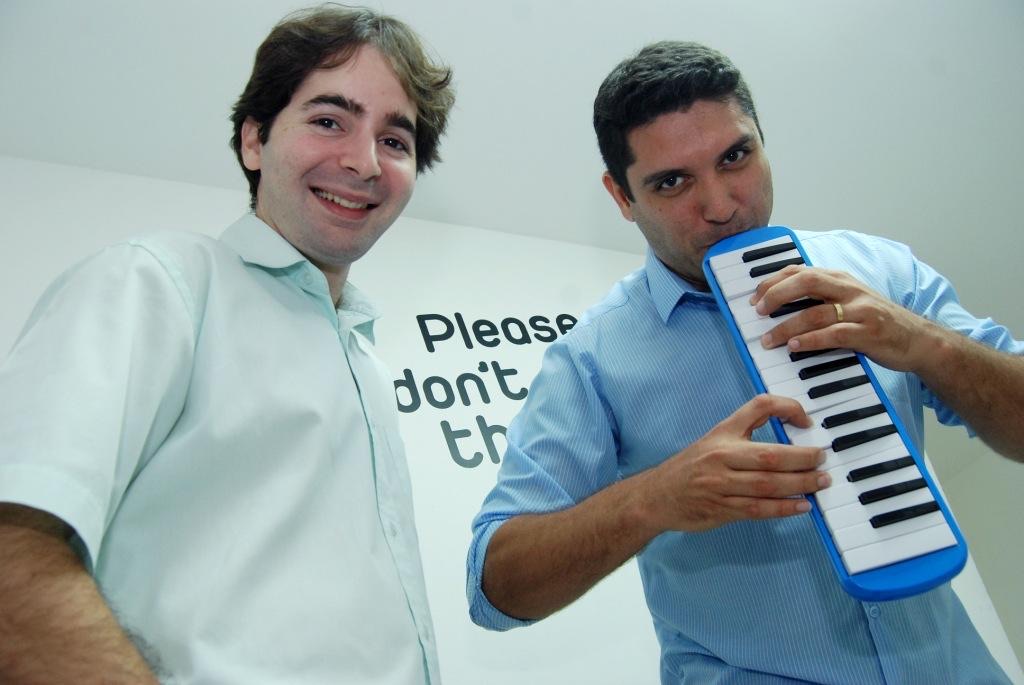
A technology development project with CNPq, FINEP and Escribo (2010–2014): a system with three views — games and applications for the student, a complete introductory music course for the teacher, indicators for management — "so that schools could offer music classes even without licensed teachers". It produced 32 educational games registered with Lattes (2010–2012) and 20 didactic animation videos, with pedagogical consulting from Cecília Cavalieri França and the team of Waldcelma Silveira, Renan Lima, Fabio Florencio, Francisco Spencer and Frank Urben. Giordano Cabral was an RHAE/CNPq scholarship researcher at Escribo (2008–2010) and technology and creative director (2010). The printed material: Turma do Som — Livro 1 and Manual do Professor (2012) and the four 2011 Daccord courses — musical creation, recorder, keyboard and guitar —, each with a student book and a teacher book. Presentations at ABEM 2011 (Vitória) and ISME 2014 (Porto Alegre, Dealing with Challenges in Music Education through Active Music Making, with Cavalieri França, Magali Kleber, Vania Fialho and Juciane Araldi Beltrame). The May 2012 press kit presents the product as a response to the law's deadline; the Instituto Claro covered the platform in use at the school in December 2012.
Nós da Educação — Música · 2014
A textbook for the fourth and fifth years of elementary school, Editora Ática, São Paulo, 98 pp., ISBN 9788508165995, with Cecília Cavalieri França, Magali Kleber, Juciane Araldi Beltrame, Cleusa Cacione, and Vania Malagutti Fialho. It is the only authored book listed in the CV; it is no longer in the publisher's current catalog.
Games, gamification, and virtual reality in schools · 2017–2019
Motivational Impact of Virtual Reality on Game-Based Learning: Comparative Study of Immersive and Non-Immersive Approaches, with Tassio de Souza Silva, Edwin Marinho, and Kiev Gama (SVR 2017, Curitiba; doi.org/10.1109/SVR.2017.28), compares the motivational impact of immersive and non-immersive games among students at NAVE Recife; it is the second most cited work in the CV. The chapter Beyond the Fun: Games and Gamification Under the Pedagogy for Liberation, with Yvonne Costa Carvalho and Veronica Teichrieb (Handbook of Research on Immersive Digital Games in Educational Environments, IGI Global, 2019, ch. 14; doi.org/10.4018/978-1-5225-5790-6.ch014), examines case studies of commercial games and gamification in a Brazilian school through the lens of the pedagogy of liberation. The master's theses by Diego Leonardo Chaves Silva (gamification in a continuous classroom feedback system, 2017) and Rogério Barreto Martins (educational games at Instituto Federal Baiano, 2017) date from the same period.
Teacher training · 2016–2019
ProfLab — Formações Criativas para Professores, a teaching project running since 2016, with Augusto Noronha and Karla Vidal; the short courses Gamificação na Educação (2017), ProfLab — Game Design Thinking (2018), and Game Design Thinking para Educadores (2019); and Rede Brasileira de Aprendizagem Criativa (Brazilian Creative Learning Network) (2018–, with Guilherme Sandler). The workshop is described on the ProfLab page.
Computational thinking and gender in elementary and lower secondary education · 2021–2025
With Mychelline Souto Cunha and Liliane Sheyla da Silva Fonseca (Unicap): gender-sensitive teaching materials (EDUCOMP 2021; doi.org/10.5753/educomp_estendido.2021.14878); the storytelling work Pensando computacionalmente com Ana, developed from the four sources of self-efficacy and validated by experts (SBIE 2022; doi.org/10.5753/sbie.2022.224948 — the most cited education paper on my CV in Crossref, with 10 citations as of September 24, 2026); the systematic review of 36 studies on gender and computational thinking (RENOTE 21, 2023; doi.org/10.22456/1679-1916.134331); and Mychelline Souto Cunha's doctoral dissertation, Abordagem sensível ao gênero para o ensino do pensamento computacional no Fundamental I (dissertation no. 660 at PPGCC/UFPE, February 24, 2025, primary advisor; CIn portal).
MOOCs, peer learning and technology in schools · 2013–2017
Master's theses by Vivian Facundes Dantas (a MOOC platform from a connectivist perspective, 2017), Paulo Roberto de Souza Mesquita Junior (collaborative peer learning supported by a social network, 2017), Adelito Farias (human–computer interaction in educational technologies, UFRPE, 2014) and, as co-advisor, Sofia Galvão Lima (technology education in primary and secondary schools, 2013 and 2015).
Higher education in computing and innovation · 2018–2023
The Porto Digital Residency Program has been listed on Lattes as an extension project since 2018, under Cabral's responsibility; the Center for Entrepreneurship and Innovation Education (teaching project, 2019–, led by Geber Ramalho) consolidates the practice of the Projetão course at UFPE since 2005. The evaluation of this training design was published as an article: Mercado de trabalho em TI: análise de um experimento de aproximação entre academia e indústria no Porto Digital, with Marcela Valença, Wellynton Diniz, Mariana Pincovsky and César França (VIII WASHES 2023; doi.org/10.5753/washes.2023.229309).
Public education policy · 2023–2025
Postdoctoral research at the Lemann Center for Educational Entrepreneurship and Innovation in Brazil, Stanford Graduate School of Education, as a Visiting Scholar for 2023–2024, with a CAPES fellowship (profile at the Lemann Center). In 2025, the project Preparing Brazil's Youth: Integrating Vocational Training into Schools, from Stanford Impact Labs (principal investigator Eric Bettinger; partners Pernambuco Department of Education, Fundação Itaú, CESAR School and Lemann Center), tests two models of vocational education integrated into secondary school in public schools in Pernambuco, with randomized and quasi-experimental evaluation; Cabral is part of the project team.
Measuring how students work with AI
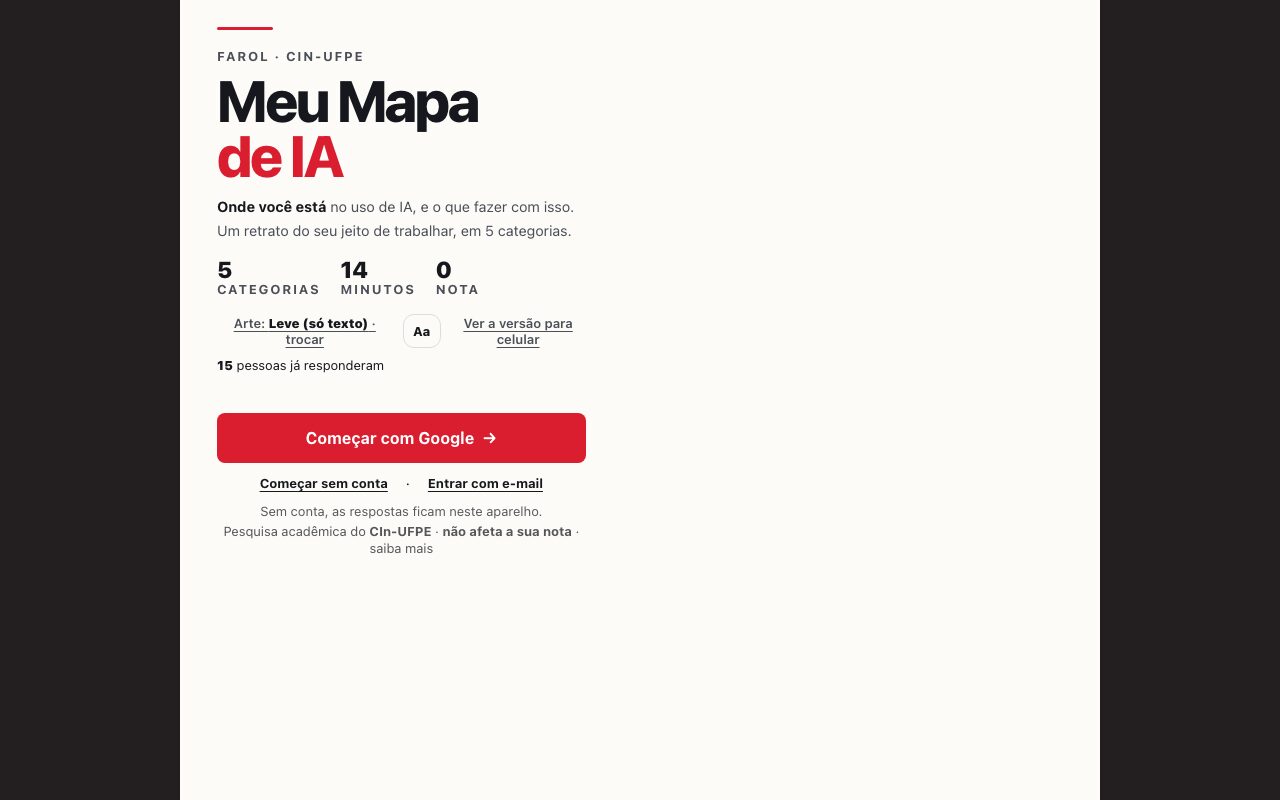
FAROL's Meu Mapa de IA surveys how Brazilian students work with AI — access, knowledge, what they can do and justify — and reports the aggregate results to the CIn AI Observatory: 2,943 responses in the September 14, 2026 snapshot, with all cells containing fewer than five responses suppressed. It is described under the agentic artificial intelligence research area.
02 · Education and educational technologies
With whom
Cecília Cavalieri França; Mychelline Souto Cunha and Liliane Sheyla da Silva Fonseca; Kiev Gama; Yvonne Costa Carvalho and Veronica Teichrieb; Waldcelma Silveira, Renan Lima and Fabio Florencio; Erika Pessoa Araujo, Evandro Natividade and Anuacy Fontes; Augusto Noronha and Karla Vidal; Marcela Valença, Wellynton Diniz, Mariana Pincovsky and César França; Geber Ramalho.
Continued in: Teaching, the Residência Tecnológica do Porto Digital and the text AI and education.