biography · 1994–2026
Who is Giordano Cabral, and where has he worked and studied?
The career narrative, by period, with what each institution Giordano Cabral passed through is and what he did at each one.
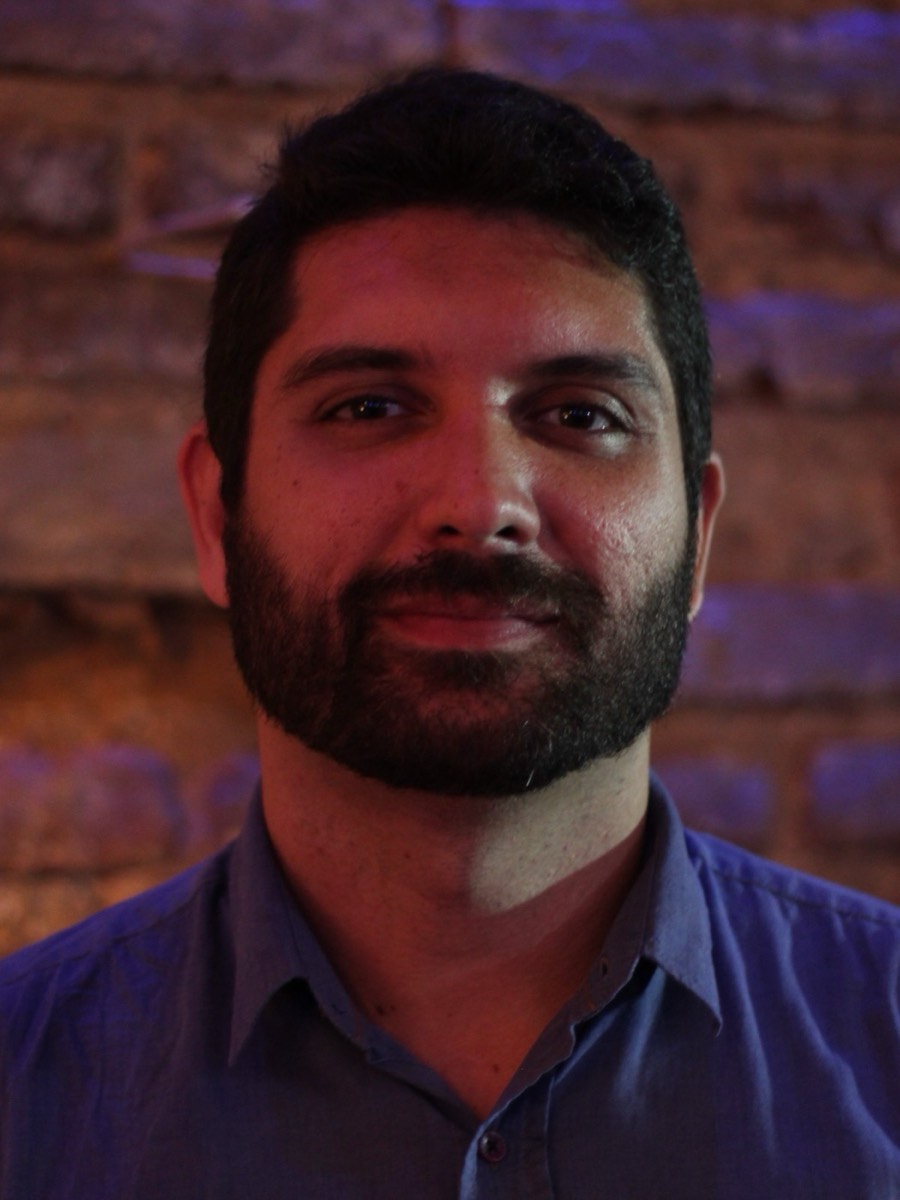
Giordano Cabral has been a professor at the Centro de Informática of UFPE since 2014, in full-time dedication, and works with agentic artificial intelligence and with strategy in organizations. He researches agentic AI and its adoption by organizations at FAROL (2025–). In strategy and business, he served for eleven years on the Board of Directors of CESAR — vice-president from 2015 to 2020 and president from 2020 to 2026 —, is a founding associate and board member of ARIES, sits on the technical-scientific council of Instituto Caldeira and on the Municipal Council for Science, Technology and Innovation of Recife, is an internationalization consultant to the Management Nucleus of Porto Digital and provides consulting to companies on strategy and AI adoption. He founded D'Accord Music Software, a software company created in Recife in 2000, and MusiGames Studio, in 2007. He earned his doctorate in Computer Science in Paris, in 2008, at LIP6, with collaboration from Sony CSL Paris; he was a Visiting Scholar at the Lemann Center, at Stanford (2023–2024), and a professor at the Universidade Federal Rural de Pernambuco from 2010 to 2014. At the origin of the research is the application of AI to computational creativity — systems that generate real-time musical accompaniment and harmonization (1999–2015), automatic audio and music analysis, digital instruments, games, multimedia — and to education.
01 · About
Through 1999 — education in Recife
He joined UFPE in 1994, in the bachelor's program in Computer Science at what was then the Departamento de Informática, on a CNPq undergraduate research scholarship, and graduated in August 1999. In March 1997 a group of students founded CITi, the Center's junior enterprise — IT consulting, software and courses — and he was among the founders: courses director in the first year, president-director in 1998, and board member until 2000.
02 · About
2000–2009 — Paris and the companies
The master's degree (2000–2002), with Geber Ramalho, came out of the project Intelligent Agents for Complex Environments (Agentes Inteligentes para Ambientes Complexos), on agents that generate real-time musical accompaniment. The dissertation, D'Accord Guitar, defended in November 2002, is a system that takes a song's chord chart and produces the guitar performance: it chooses the positions on the fretboard, models the guitarist's hand and animates the performance for those learning.
In the same year the master's began, the system became a company. D'Accord Music Software was born in 2000 within CIn's music computing group, was pre-incubated at Recife BEAT — the Center's high-tech business incubator — and was incorporated as a corporation in 2001. Cabral was development lead; the Violão Player, from 2001, was the first product. By 2003 the company was selling to the United States and Europe; in 2004 it was among the founding companies of Porto Digital. In the Prêmio Finep de Inovação, Small Business category, Northeast stage, it placed third in 2007, second in 2008 and first in 2009, when it was a national finalist; it won the regional stage again in 2012. It received R$1.68 million in economic subvention from FINEP in 2008 and investment from Fundo Criatec, BNDES's seed capital fund, in 2010. Today there are two legal entities: the 2001 corporation, which from 2014 has operated as Escribo, and Daccord Tecnologia Ltda, opened in 2014, which uses the brand and in which he has been a partner since 2018, alongside Rodrigo Pereira, who runs it, and Filipe Calegário.
From 2003 to 2008 he did his doctorate at LIP6, the computer science laboratory of the Université Pierre et Marie Curie (Paris 6, today Sorbonne Université), in the multi-agent systems team, with a CAPES scholarship. Jean-Pierre Briot supervised the thesis; François Pachet, of the Sony Computer Science Laboratory Paris, co-supervised it; from 2003 to 2007 he worked with the laboratory's music team at Sony. In 2005 he taught the supervised coursework in Introduction to Artificial Intelligence at the university. The thesis, Harmonisation automatique en temps réel, deals with a system that harmonizes an improvised melody in real time, from partial information; it was defended on July 9, 2008, with the distinction très honorable, and UFPE recognized the degree in 2010. Also from the doctorate is the validation of EDS, a Sony CSL system that automatically discovers audio descriptors, in a chord recognizer (ISMIR 2005).
The collaboration with Sony CSL continued after the thesis: in 2015, a demonstration at IJCAI, with Mathieu Ramona and François Pachet, of a system that generates the accompaniment of a song from the recording of a single performer; in 2017, Brazyle, a Brazilian style base registered with Pachet, which Daccord states was used in the Flow Machines project. From Flow Machines came the album Hello World (2018); on the official credits page, Cabral's name appears in the acknowledgments list.
He returned to Brazil in 2007, before the defense, and worked in Rio de Janeiro, from February 2007 to June 2008, as a developer, software engineer and later project lead at DATASUS — the information technology department of the SUS —, hired through CTIS. From the same period comes his collaboration with researchers at IMPA.
In 2007 Daccord opened MusiGames Studio at Porto Digital, a music games unit, to put into games the audio technology it already had. He was the company's chief technology officer from June 2008 to May 2010. Drums Challenge launched on the App Store in June 2009 and closed the month among the best-selling music games in the United States and the United Kingdom; the iPad version, from April 2010, led the category in the United States. In 2009 he organized, with Geber Ramalho, in Recife, the 12th Simpósio Brasileiro de Computação Musical, on behalf of the company, and from 2009 to 2010 he taught in the Produção Fonográfica program at Faculdades Integradas Barros Melo.
03 · About
2010–2014 — UFRPE
The Universidade Federal Rural de Pernambuco, founded in 1947, is headquartered in Dois Irmãos, in Recife, with units in Serra Talhada, Belo Jardim and Cabo de Santo Agostinho: about 16,000 students, 1,300 faculty members and 54 undergraduate programs. The Department of Statistics and Informatics houses the Bachelor's in Sistemas de Informação (Information Systems), created in 2008 under REUNI, with its first class in 2009. He was appointed adjunct professor in May 2010 and remained until August 2014. He coordinated the program — created a year earlier — and the laboratories from 2011 to 2014; he was deputy head of the department from 2012 to 2014, a member of the university's Council for Teaching, Research and Extension, of the graduate program collegiate body in Applied Informatics and of the program's collegiate body, deputy coordinator of extension, and institutional representative of the Sociedade Brasileira de Computação (Brazilian Computer Society). From 2011 to 2014 he held the CNPq productivity fellowship in technological development and innovative extension, level 2. Outside the university, he served on the advisory board of PRAISE, a European project on tutoring agents in musical communities of practice.
During this period, the research gained its own groups and funding. MusTIC — Música, Tecnologia, Interatividade e Criatividade (Music, Technology, Interactivity and Creativity) — was founded in 2011 and received a CNPq Universal grant in 2013 for a method for creating digital musical instruments. The audio-monitoring project for public safety (CNPq and FACEPE, 2010–2014) trained classifiers to recognize gunshots and screams from microphones. PsyFun — digital games for cognitive psychology — began in 2013 with the Decisores Virtuais (Virtual Deciders) project, funded by FACEPE. He supervised four master's students at UFRPE.
At the company, he took charge of the education division: CNPq RHAE program research fellow from 2008 to 2010, director of technology and creation in 2010. The Plataforma Digital de Educação Musical (Digital Music Education Platform) (CNPq, FINEP and Escribo, 2010–2014) responded to Law 11.769/2008, which made music content mandatory in schools without enough licensed music teachers to teach it: games for students, courses for teachers, indicators for management. It produced Turma do Som (2012, with pedagogical consulting by Cecília Cavalieri França) and the book Nós da Educação — Música, for 4th and 5th grades, published by Ática (2014). In 2014 the corporation began operating as Escribo — Inovação para o Aprendizado (Escribo — Innovation for Learning); Cabral left the company in 2017.
04 · About
2014– — CIn/UFPE
The Centro de Informática was founded as the Department of Statistics and Informatics in 1974, became a separate Department of Informatics in 1983, and turned into a Center in 1999. It has four undergraduate programs — Computer Science (1974), Computer Engineering (2002), Information Systems (2010) and Artificial Intelligence (2025) —, academic and professional master's and doctoral programs with the top CAPES rating, one of only seven computing centers in the country at that level, more than twenty laboratories, and an incubator. CESAR (1996), CITi (1997) and Porto Digital (2000) all emerged from it. Cabral has been an adjunct professor at the Center since 2014.
He has been part of PRAIA — Centro de Pesquisa Realmente Aplicada em Inteligência Artificial (Really Applied Artificial Intelligence Research Center) — since 2020, with about a hundred researchers from UFPE, UPE and UFRN, coordinated by Geber Ramalho. He teaches Introdução à Multimídia (Introduction to Multimedia), Projetão, Computação Musical (Musical Computing), Jogos Digitais (Digital Games), Criatividade Computacional (Computational Creativity) and, since 2026, Tendências em Mídia e Interação (Trends in Media and Interaction) — sixty classes since 2015. He coordinates MusTIC with Geber Ramalho and Filipe Calegário; the group described itself in a 2019 article as having five axes, 21 projects and 42 researchers, and is on the Center's official list of research groups. He has advised two doctoral theses — VioLED, by Eduardo Santos Silva (2022), and the gender-sensitive approach to teaching computational thinking in early elementary school (Fundamental I), by Mychelline Souto Cunha (2025) — and fourteen master's dissertations, in addition to ten master's co-advisings; the list is at Advising. With Filipe Calegário, he coordinated the 18th SBCM (2021), held by CIn with CESAR, and proposed to CNPq the 2019 National Science and Technology Week in Pernambuco.
Since October 2022 he has been president of Alumni CIn, the Center's alumni association, elected for the 2022–2025 term. At the Sociedade Brasileira de Computação, he served on the steering committee of the Special Committee on Music Computing — which organizes the biennial SBCM — in 2011–2014, 2015–2017 and 2021–2022, and chaired it in the 2022–2023 term, with Filipe Calegário as vice-chair.
05 · About
2015–2026 — boards, strategy and the ecosystem
CESAR — Centro de Estudos e Sistemas Avançados do Recife — is a private nonprofit innovation institute, founded in 1996 by Silvio Meira, Ismar Kaufman and Fábio Silva, professors at CIn, and an anchor institution of Porto Digital. It describes itself as a school, an experimentation laboratory, a research and development center and a venture builder. In 2026, it reports locations in Recife, Manaus, São Paulo, Rio de Janeiro, Curitiba and Florida, as well as an operation in Aveiro, Portugal, announced in 2023; 136 projects and 95 clients per year, a thousand startups supported in two years and 4,500 students at CESAR School, whose professional graduate programs began in 2007 and whose professional doctorate in Software Engineering dates to 2019. Its governance comprises a General Assembly of Members, a Board of Directors and an Executive Board. The institute turned thirty in 2026.
Cabral joined the Board of Directors in January 2015 as vice president and chaired it from 2020 to 2026. He completed board member training programs at Fundação Dom Cabral (2015) and IBGC (2019). During this period, and by decision of the board, the Board received the Women on Board certificate (2021); the institute signed a memorandum with Covilhã (2022), opened an operation in Aveiro (2023) and signed a protocol with CCG/ZGDV in Guimarães (2025); launched, with the Government of Pernambuco, SENAI and SENAC, Florescendo Talentos (2024), technical courses in around 170 state schools across more than 70 municipalities; took the Smart Lipstick prototype to CES 2025, where it won the People's Choice at the SXSW Innovation Awards; and published its first Socio-Environmental Impact Report (2025), which opens with a message from her as president. During this time, he authored articles on innovation as behavioral change (2020) and on generative AI (2023), and the preface to O futuro das organizações pela perspectiva Design-Driven (2023).
ARIES — the Recife Agency for Innovation and Strategy — is a private nonprofit association, registered in 2017 and active since 2018, classified as a Social Organization by the municipality, created to think through Recife's long-term development. It has five founding members: Guilherme Cavalcanti, Sérgio Cavalcante, Fernando Holanda, Fernando Braga and Giordano Cabral. The work that defines it is the Plano Recife 500 Anos, the city's strategic plan with a horizon of 2037, produced under a management contract between the City of Recife and the Porto Digital Management Unit and published in a second edition by Cepe in 2022. In 2025 the agency began carrying out two projects with public funding: the inclusive upgrading of the Cajueiro Macro-area (R$ 2.4 million, through 2027) and, as delegated manager on the Brazilian side, FICOL 2, part of the Recife–Nantes cooperation, funded by the French Development Agency — €2.21 million through 2028, with UFPE, Unicap, Porto Digital and CESAR as partners. Cabral is a member of the Board of Directors.
Porto Digital is Recife's technology park, created in July 2000 as a State public policy, with R$ 33 million in initial investment, and run by the Porto Digital Management Unit, a private nonprofit association classified as a Social Organization in 2001, which operates under a management contract with the Government of Pernambuco. The 2025 results, released in March 2026, show 541 companies, 24,079 employees and revenue of R$ 7.4 billion, 19% above the previous year. Cabral's involvement in the park takes place through two training programs. The Residência Tecnológica (Technology Residency), from 2019, is a course integrated into technology degree programs at six institutions, in which student squads solve real challenges proposed by more than a hundred companies, with mentors from the market and cycles closed by a demo day; in the second semester of 2025 it served about 2,300 students in Recife and 3,700 when adding Aracaju and Brasília. The Embarque Digital (Digital Onboarding), introduced in 2021 by the City of Recife with the park as technical partner, gives full scholarships in higher-education technology courses to those who completed all of secondary school in the public school system: 3,043 enrollees and 1,130 graduates as of September 2026. He has coordinated the Residency's pedagogy since 2019 — the CIn portal described him this way in September 2021. He is co-author of the study on the program presented at WASHES 2023 and a consultant to the Management Unit for the park's internationalization and the Recife–Nantes cooperation. The coordination role was paid, from 2022 to 2025, through research, development and innovation grants from Softex Recife — an association within the Softex network that has maintained, under a 2023 administrative order, a grant program funded by companies and public entities.
Since October 2024 he has been an alternate member, representing CESAR, of the Recife Municipal Council for Science, Technology and Innovation, created by Law 18.974/2024 to propose and evaluate the city's innovation policies. In 2026 Instituto Caldeira — an innovation hub in Porto Alegre, founded in 2019 by a group of major companies from Rio Grande do Sul — created a technical-scientific council, in which Cabral participates remotely; the institute does not publish the council's composition.
Outside of boards, he provides consulting to companies in strategy and business intelligence and in the adoption of artificial intelligence, treated as an element of business transformation (statement by Giordano Cabral, September 27, 2026). The detail of each board and each company is at Strategy and business.
06 · About
2023–2024 — Stanford
The Lemann Center for Educational Entrepreneurship and Innovation in Brazil is a center at the Stanford Graduate School of Education, created in 2011 to support lasting improvements in the Brazilian educational system, with a focus on students historically disadvantaged by race, region and class. He was a Visiting Scholar for the 2023–2024 program year, from August to August, with a CAPES fellowship and UFPE and CESAR affiliation; Lattes records the period as a postdoctoral fellowship. The period produced three texts with Jean-Pierre Briot on artificial intelligence in Brazil (2024) and participation in the team of Preparing Brazil's Youth: Integrating Vocational Training into Schools, a project funded by Stanford Impact Labs in 2025, with Eric Bettinger as principal investigator and the Pernambuco State Department of Education, the Itaú Foundation, CESAR School and the Lemann Center as partners. The project tests two models of vocational education integrated into high school — renewable energy courses in rural schools and technology electives in more than 130 public schools across the state — with randomized and quasi-experimental evaluation.
07 · About
2025– — FAROL and agentic AI
In 2025 Cabral created FAROL with Filipe Calegário at CIn, a group that measures how organizations and people work with agentic artificial intelligence. The scale has six axes and five levels; from it derive Meu Mapa de IA, the Índice de IA para PMEs, the Arsenal of Tools catalog and the Arena das IAs, whose first experiment was the 2026 World Cup Bolão — 124 models, 104 matches, 5,797 predictions between June 11 and July 19. The group is not listed among the Center's official research groups. In the same year he created the course Tendências em Mídia e Interação, in which each student builds their own AI-based prospecting tool.
08 · About
Institutions and international cooperation
Cooperation with France runs through the curriculum from 2001 to 2024: the Smart-es project, between UFPE and Université Paris VI (2001–2004), on learning and adaptation techniques for e-commerce, games and internet search; the doctorate at LIP6, with Jean-Pierre Briot, and co-advising by François Pachet, of Sony CSL Paris, Sony's research laboratory in Europe, from which the Flow Machines project emerged; the doctoral committees at IMPA with both of them (2009 and 2010); and the three texts with Briot from 2024. Also on record is a stint at Spotify CTRL, in Paris. With IMPA, in Rio de Janeiro, there are co-authorships with Luiz Velho (SBCM 2007, SIGGRAPH 2010). In the European Union, he served from 2012 to 2014 on the advisory board of PRAISE, a project of the 7th Framework Programme coordinated by CSIC, with €2.3 million from the EU (CORDIS). With McGill University and Inria, he co-authors with Marcelo Wanderley and Stéphane Huot the method and toolkit for digital musical instruments (IEEE MultiMedia, 2017), the most cited work in his record. In the United States, the Lemann Center, at Stanford (2023–2024), and the Stanford Impact Labs (2025). Through Porto Digital, he has led, since 2019, as internationalization consultant, the Brazilian side of the Recife–Nantes cooperation, with ADN Ouest and Nantes Métropole, in which ARIES carries out FICOL 2. During the period in which he chaired the CESAR Board, the institute signed a memorandum with Covilhã (2022), opened an operation in Aveiro (2023) and signed a protocol with CCG/ZGDV of Guimarães (2025).
09 · About
Contact
Identifiers for those who need to check research output and citations: Lattes · ORCID · Google Scholar · DBLP · OpenAlex · Semantic Scholar · GitHub · LinkedIn. The most recent work recorded on Lattes is from 2023; claims the sources do not support are covered in the verification notes.
Centro de Informática da UFPE, sala C120, Bloco C, 1º andar. Av. Jornalista Aníbal Fernandes, s/n, Cidade Universitária, Recife, PE, 50740-560. Email grec@cin.ufpe.br. Telephone +55 81 2126-8430, extension 4333.
Frequently asked questions
Who is Giordano Cabral?
Giordano Ribeiro Eulálio Cabral has been an associate professor at the Center for Informatics of UFPE since 2014, on an exclusive full-time basis. He works with agentic artificial intelligence and with strategy in organizations: he researches AI adoption by organizations, chaired the CESAR Board of Directors from 2020 to 2026, is a board member of ARIES, and provides consulting to companies in strategy and AI adoption. He coordinates FAROL, with Filipe Calegário, and MusTIC, with Geber Ramalho and Filipe Calegário.
What does Giordano Cabral work on in companies and institutions?
With strategy and the adoption of artificial intelligence. He was a member of the CESAR Board of Directors from 2015 to 2026, the last five years as chair; he is a founding associate and board member of ARIES, is a member of the technical-scientific council of Instituto Caldeira, and is an alternate member of the Recife Municipal Council for Science, Technology and Innovation. He has been an internationalization consultant for the Porto Digital Management Unit since 2019 and provides consulting to companies in strategy and business intelligence, with AI as an element of business transformation.
What is Giordano Cabral's educational background?
Bachelor's degree in Computer Science from UFPE (1999) and a master's degree from the same institution (2002), supervised by Geber Ramalho. PhD in Computer Science from Université Pierre et Marie Curie, at LIP6 in Paris, supervised by Jean-Pierre Briot and François Pachet, defended in 2008. Visiting Scholar at the Lemann Center at Stanford University in 2023–2024, with a CAPES fellowship.
Which institutions is Giordano Cabral affiliated with, or has he been affiliated with?
CIn/UFPE, as a professor since 2014; UFRPE, as a professor from 2010 to 2014; Daccord Music Software, which he founded in 2000 and of whose successor, Daccord Tecnologia, he is a partner; CESAR, whose Board of Directors he served on from 2015 to 2026, the last five years as chair; ARIES, of which he is a founding associate and board member; Instituto Caldeira, on the technical-scientific council since 2026; Porto Digital, where he coordinates the pedagogy of the Residência Tecnológica (Technology Residency) and has been an internationalization consultant since 2019; Alumni CIn, which he has chaired since 2022; and the Recife Municipal Council for Science, Technology and Innovation, as an alternate for CESAR. Outside the country: LIP6 and Sony CSL, in Paris, during his doctorate (2003–2008); the European project PRAISE (2012–2014); the Lemann Center, at Stanford (2023–2024).
How can I contact Giordano Cabral?
By institutional email at grec@cin.ufpe.br, or in room C120 at UFPE’s Center for Informatics, in Cidade Universitária, Recife. The phone number is +55 81 2126-8430, extension 4333.