Research area · 2025–
How do you measure what changes when the machine performs entire tasks within an organization?
The line studies how organizations and people work with artificial intelligence that performs entire tasks — using tools, chaining steps and acting on systems — rather than just responding. It is part of FAROL, created by Giordano Cabral in 2025 with Filipe Calegário at CIn/UFPE; the group is not on the Center's official list of groups. It has produced the six-axis scale, the AI Index for SMEs, the Agentic Fluency Map, Meu Mapa de IA, the CIn AI Observatory and the Arena das IAs (2026).
The term adopted by the group for what is measured is fluência (fluency); what it means and where the bar is set are at fluency, and the reason for not using maturity models is at agentic AI.
01 · Agentic artificial intelligence and organizations — FAROL
Contributions
The six-axis scale
Knowledge; tools and integration; delegation and autonomy; processes; productivity and results; learning and culture — each measured separately, on a scale from N0 to N5, against a master bank of 264 items across four families, fifteen main questions and three levels of depth (knowing, doing, articulating). The instrument has a tree structure: respondents select the stack of tools they actually use, and questions branch out within it.
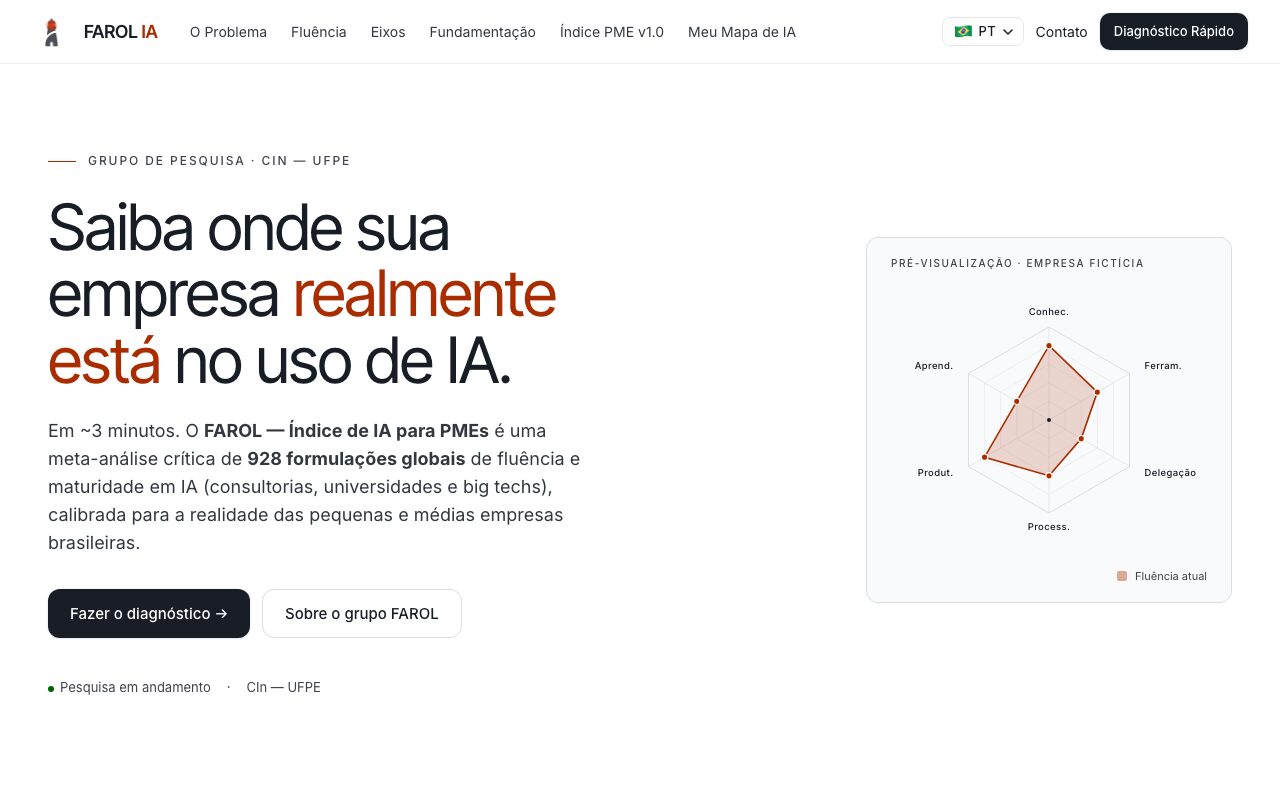
Índice de IA para PMEs
The entry diagnostic: a leader answers on behalf of the organization, in three to eight minutes, without registration, and receives a six-axis radar chart showing which side of the boundary between generative and agentic use the organization is on. Available at farol-ia.org/diagnostico.
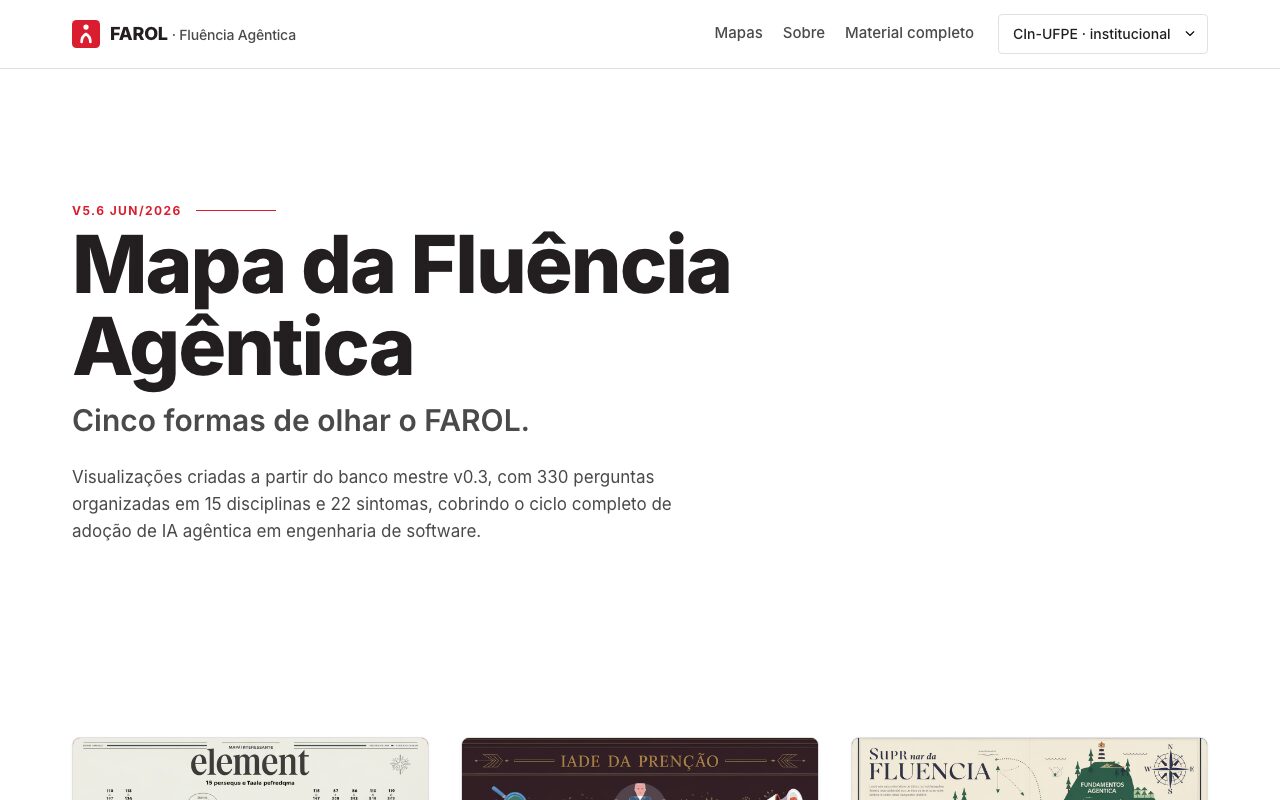
Mapa da Fluência Agêntica
The master bank of 264 items opened through five visual readings — periodic table, eras, nautical chart, factory and reading room. Curated by Giordano Cabral; visualizations and critical review by Filipe Calegário. Available at mapa-fluencia-agentica.vercel.app.
Meu Mapa de IA and the Observatório de IA do CIn
A research instrument in the form of a game that surveys how Brazilian students work with AI: what they have access to, what they know, what they can do and what they can justify. It takes about fourteen minutes on a phone and gives each person an archetype and a profile across the six axes. The rules appear on screen before the first question: responding does not affect grades, whoever organizes the class sees only aggregate data and only once there are at least five respondents, and there are no rankings of people, programs or institutions. Available at farol-ia.org/educacao/censo. The aggregate data feeds into the Observatório de IA do CIn: 2,943 responses in the data extract from September 14, 2026, with every cell containing fewer than five responses suppressed.
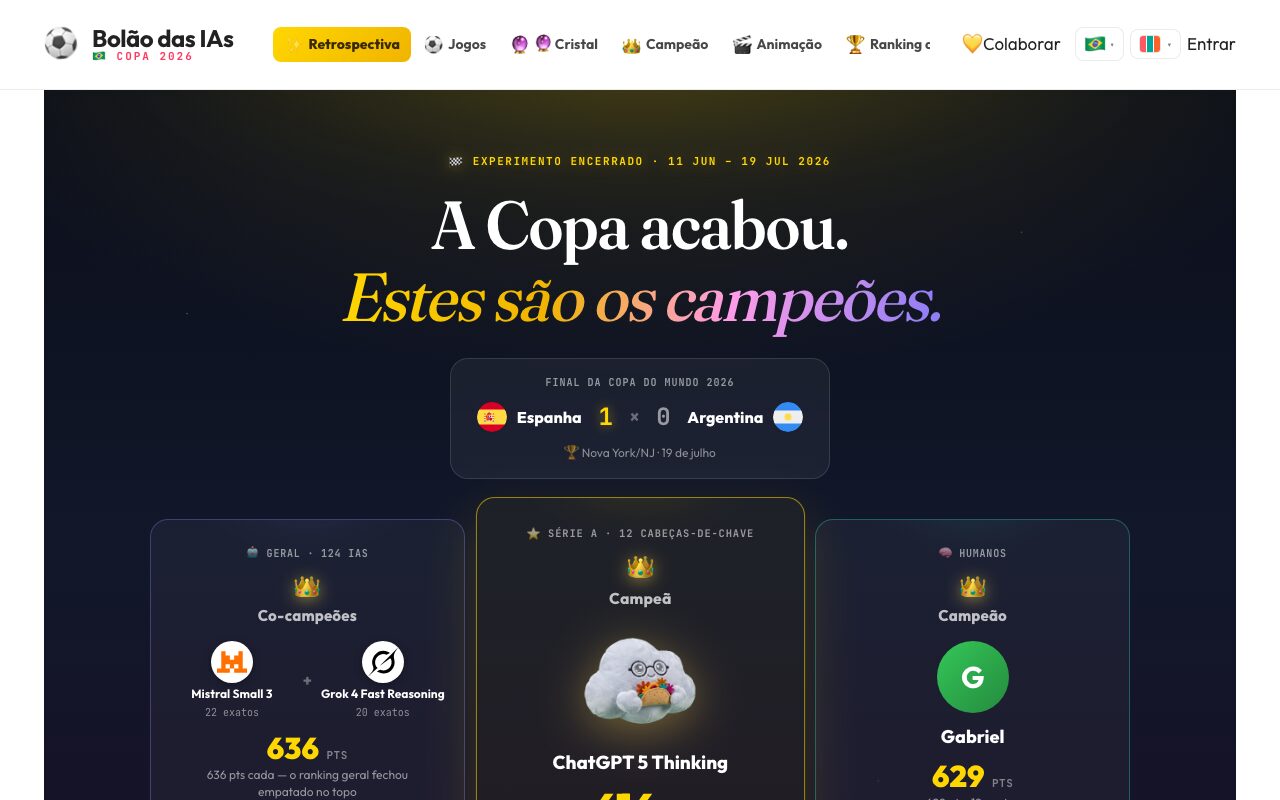
Arena das IAs — the World Cup Prediction Pool · 2026
The group's first public experiment: 124 artificial intelligence models predicted the outcomes of the 104 matches of the 2026 World Cup under office prediction pool rules, in the same ranking as human participants — 5,797 predictions over 38 days, from June 11 to July 19, 2026. The top human participant scored 629 points and finished ahead of 121 of the 124 AIs; the machines' consensus had Brazil winning the title, but Brazil was eliminated in the round of 16. The archive is available at bolao.arenadasias.com.br, with code at github.com/giordanorec/bolao-copa-2026; the CIn portal covered the launch and the conclusion. What the experiment shows, and what it does not measure, is discussed in the essay.
Open catalogs
Arsenal of Tools catalogs tools, CLIs, MCP servers, models and APIs aggregated from 632 open lists; search runs in the browser, and the site has no advertising or tracking (arsenal-of-tools.vercel.app); Acervo de Teorias Acionáveis turns management theories into teaching materials and a portable skill that an AI assistant loads (farol-ia.org/acervo). The full list, with what each instrument does and where to access it, is available under instruments.
02 · Agentic artificial intelligence and organizations — FAROL
Before FAROL
The connection to the rest of my academic record lies in the AI for music research strands from 2001 to 2015 — real-time accompaniment and music information retrieval — and in two recent records: PRAIA, Centro de Pesquisa Realmente Aplicada em Inteligência Artificial, with around one hundred researchers from UFPE, UPE and UFRN, led by Geber Ramalho (Lattes, since 2020); and three pieces with Jean-Pierre Briot on AI in Brazil, deposited in HAL in 2024 — L'Intelligence Artificielle au Brésil / AI in Brazil (hal-04545331), L'IA au Brésil: stratégies, défis et opportunités dans un marché émergent (ActuIA, July 16, 2024; hal-04663796) and the interview Innovations et défis de l'intelligence artificielle au Brésil, with Fabio Cozman (hal-05177748). These are pieces for public outreach and analysis, not peer-reviewed articles.
03 · Agentic artificial intelligence and organizations — FAROL
With whom
Filipe Calegário; the students in Tendências em Mídia e Interação, who use the instruments and contribute some of the material that becomes a study; Jean-Pierre Briot and Fabio Cozman, in the 2024 texts.
More at: farol-ia.org, instruments and in the text Agentic AI.