Education and educational technologies · 2001–
How do we teach, learn and assess when everyone already uses artificial intelligence?
The position that Giordano Cabral applies in his courses at CIn/UFPE and advocates in Porto Digital's technical training starts from the premise that all students use AI. From that follows raising the bar, because the machine does the manual work; teaching discernment, which means assessing the quality of what it produces; declaring, for each activity, the mode of use — without assistance, with assistance, or with responsibility, in which the student answers for the final decisions; and assessing the process, not just the product. In the 2026.2 syllabus for Tendências em Mídia e Interação (Trends in Media and Interaction), this is written as: “if the machine manufactures the product, the product cannot be assessed: what is assessed is the process of piloting the machine”. AI detectors are left out; the criterion is evidence of process — repository, history, justifications, tests.
01 · AI and education
What is Giordano Cabral's position on using AI in the classroom?
The position starts from two observations: prohibition does not work, and automatic detection is not a valid criterion. The starting point is to assume that everyone uses AI and treat that as the baseline.
- Raise expectations. If the machine does the grunt work, the assigned work must be more demanding.
- Teach discernment. The competencies to develop become specification, verification, debugging, risk analysis, calibration, transfer, and accountability.
- Declare the mode of use for each activity: mode 1, no AI; mode 2, AI as support, asking questions without providing the solution; mode 3, AI executes and the student orchestrates.
- Assess the process. Repository, history, justifications, and tests, because the product no longer distinguishes levels of competence.
AI detectors are excluded. The argument concerns measurement: the detector does not measure the competence we aim to develop, and it produces accusations without proof.
02 · AI and education
How does this position become a written rule in a course?
In the course Tendências em Mídia e Interação (Trends in Media and Interaction, CIN0055), the pedagogical agreement is addressed directly to the AIs students bring to the activity: the course website publishes an llms.txt file listing what the AI should and should not do.
It should: write the collector, present the arsenal and let the student choose, challenge a lazy request, show the source's bias, and say "I could not verify this". It should not: list tools from memory as though they came from a scan, invent links, choose for the student, or write up the method as though it were the student's own. The test is in the file itself: "if the student finishes this activity unable to explain, without looking anything up, why those 50 and not others — you did the work wrong, however good the result looks".
The activity this applies to is Hiper Deep Research: the student scans tens of thousands of tools with an AI and narrows them down — 10,000 scanned, 500 shortlisted, 50 selected, 5 highlighted, 1 presented. Telemetry records the time spent on each item, because reading 500 items is the work that does not show up in the result. In 2026.2, the class added 5,776 tools to the shared catalog and recorded 659 selections.
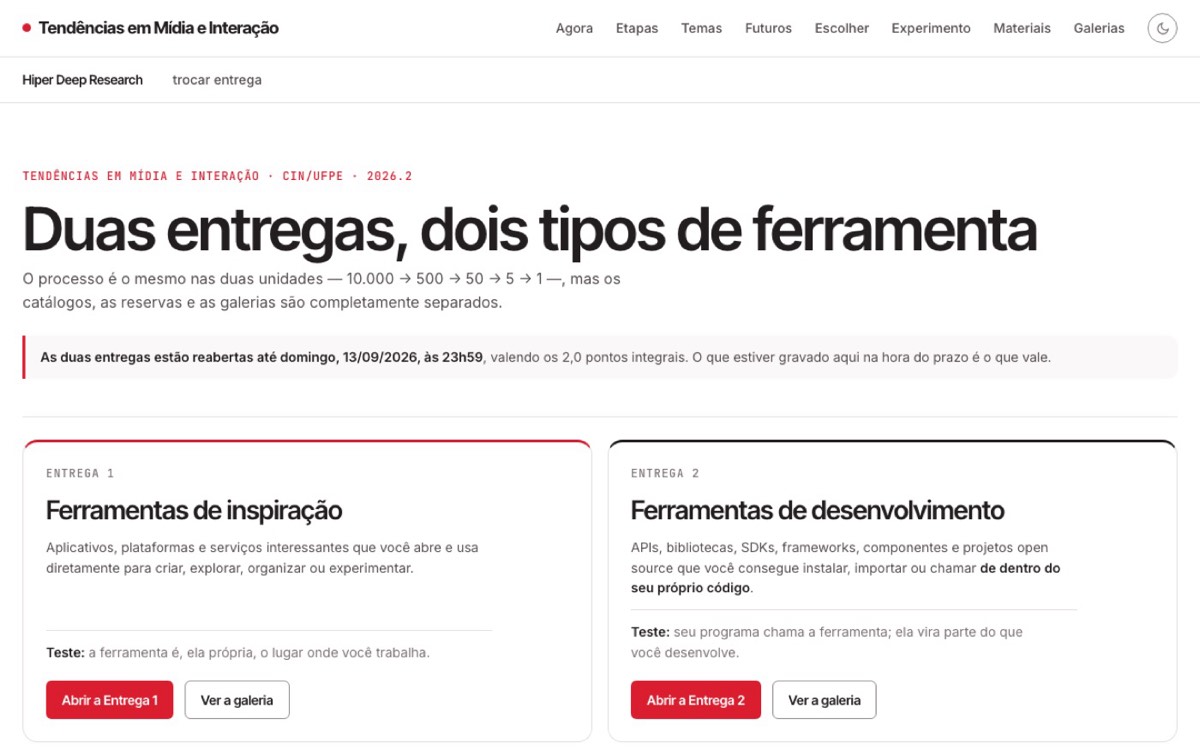
In the same course, instead of using a ready-made scouting tool, each student builds their own: a skill in Markdown that packages a method and runs in an actual agent, with four behavioral requirements — interview before running, distinguish mature from emerging using written criteria, question its own results, and produce output in the standard format. The reason is stated in the assignment: "when ten people run the same tool, ten people end up in the same place, and nothing is learned about the method — only about the tool". Nine skills were submitted in 2026.2 and read side by side, with the four requirements checked by a script.
The course website is www.cin.ufpe.br/~grec/tmi/26-2/.
03 · AI and education
How do you measure what students can actually do with AI?
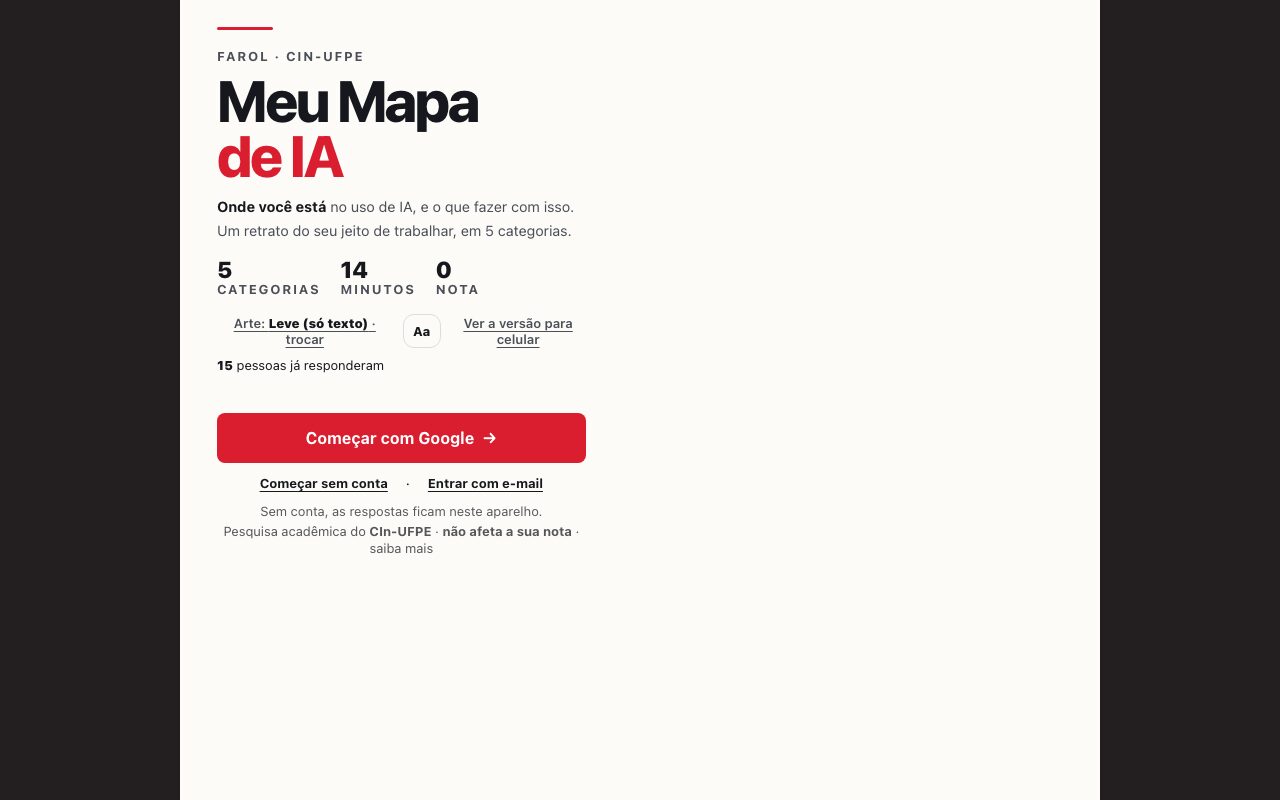
With a research instrument, rather than an exam. Meu Mapa de IA is a game-based questionnaire that surveys how Brazilian students work with AI: what they have access to, what they know, what they can do, and what they can justify. It takes about fourteen minutes on a phone, and participants leave with their own archetype and an assessment across the six dimensions of fluency.
The rules appear on screen before the first question: choosing whether to respond does not affect grades; whoever organizes the class sees only aggregate results, and only when there are at least five participants; no individual results are disclosed; and there are no rankings of people, degree programs, or institutions.
https://farol-ia.org/educacao/censo
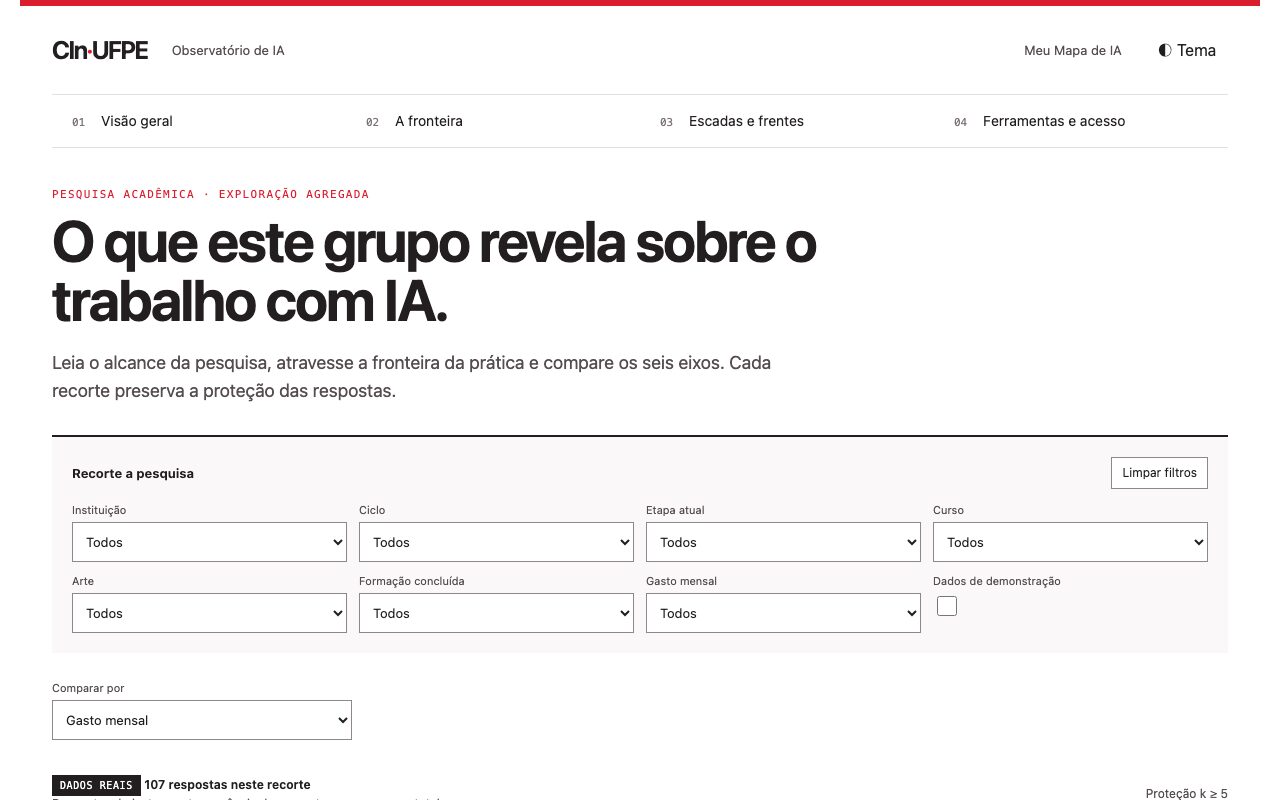
The data collected by the instrument is returned in aggregate in the Observatório de IA do CIn, a public dashboard with four sections — overview, the frontier of practice, ladders and fronts, tools and access — with breakdowns by institution, cycle, degree program, and monthly spending on AI. As viewed on September 18, 2026, using data extracted from the database on September 14, 2026: 2,943 responses in the full snapshot, 1,394,729 cells suppressed by the k ≥ 5 protection rule, and 17,396 unavailable breakdowns. The dashboard itself cautions that the survey is cross-sectional and self-reported: the cycles do not track the same people, and the chart does not demonstrate progress caused by education.
04 · AI and education
What is Giordano Cabral's role in technical training at scale, outside the university?
Since September 30, 2019, without interruption, Cabral has been the pedagogical coordinator of the Residência Profissional Tecnológica (Professional Technology Residency) at Porto Digital, the technology park of Recife.
The program's origin lies in a 2019 diagnosis: Porto Digital had more than a thousand open positions across 355 companies going unfilled, and the previous program, "Empregaço," enrolled more than 700 IT graduates and employed fewer than 5% of them. Invited to redesign the model, Cabral consulted institutions, students and companies and designed the Residência em Desenvolvimento de Software (Software Development Residency): cycles closed out by demo days, squads of students working on real challenges proposed by companies, and market mentors alongside the professors. In the first cohort, employability reached almost 100%.
In 2020 the model was adopted as public policy by the City of Recife together with Porto Digital: Embarque Digital, a scholarship program for students who completed all of high school in public school. Results cited in the article published by Cabral on January 10, 2024: a doubling of the supply of IT courses in the city, 2,000 scholarships, more than half of the scholarship recipients being the first generation in their family to reach higher education, dropout cut in half, 51.8% of the first cohort employed before graduating, and a greater presence of Black, Brown, and female people in the ecosystem.
In 2026, Embarque Digital reports 3,927 students, 97 companies, 330 projects, and 47 mentors, with a plan for 4,000 scholarships by 2028. The residency operates in Recife, Aracaju, and Brasília, with more than 100 partner companies; in the second half of 2025, there were more than 40 companies and more than 70 mentoring engagements for around 2,300 students in Recife, out of a total of 3,700 across the three cities.
- Residência Tecnológica:
https://www.portodigital.org/paginas-institucionais/pessoas/residencia-tecnologica - Embarque Digital:
https://www.portodigital.org/paginas-institucionais/pessoas/embarque-digital
The program's design was the subject of a peer-reviewed article. Mercado de trabalho em Tecnologia da Comunicação e Informação (TI): análise de um experimento de aproximação entre academia e indústria no Porto Digital, by Marcela Valença, Wellynton Diniz, Mariana Pincovsky, César França and Giordano Cabral, was published at VIII WASHES, in 2023 (doi.org/10.5753/washes.2023.229309).
05 · AI and education
What did Giordano Cabral research at Stanford?
Between 2023 and 2024 he completed a postdoctoral fellowship at the Lemann Center at Stanford University, on a CAPES scholarship, in educational public policy (lemanncenter.stanford.edu/people/giordano-cabral). The research object was the training program he coordinates at Porto Digital.
Since January 2025 he has been part of the Florescendo Talentos team, a study on the effectiveness of a technical track in state high schools, conducted by CESAR with the Lemann Center and the Pernambuco State Department of Education.
06 · AI and education
Where does education feature before generative AI?
Cabral's work in education began about two decades before generative AI.
- 2001–2017 — Escribo. Co-founder of the learning technology company; RHAE/CNPq research fellow from 2008 to 2010 and director of technology and creative development in 2010.
- 2008–2014 — Turma do Som. A digital music education platform funded by CNPq, FINEP and Escribo, with about thirty educational games, 27 didactic animation videos produced between 2010 and 2012, a portal and printed material, in schools since 2008, with content coordination by Cecília Cavalieri França. This item has two public sources: the platform's press kit, from May 2012, which describes it as a response to the deadline set by Law No. 11.769/2008 and records teacher training alongside the didactic material and offerings to Departments of Education; and the Instituto Claro article of 04/12/2012, which shows it in use at school and interviews Cabral. In October 2012 the company won the Northeast stage of the Finep Innovation Award with its two education projects — Turma do Som and Saiba+ Enem.
- 2011–2014 — teaching materials. The Daccord courses in acoustic guitar, keyboard, recorder and music creation, each with a teacher's book and a student's book; Turma do Som — Livro 1 and the teacher's manual (2012); and Nós da Educação — Música (4º e 5º Ano), published by Editora Ática in 2014.
- 2016–2019 — teacher training. ProfLab, a series of creative training sessions for teachers, with Augusto Noronha and Karla Vidal, and courses in gamification in education and game design thinking for educators.
- 2021–2023 — gender-sensitive computational thinking. With Mychelline Souto Cunha and Liliane Sheyla da Silva Fonseca: teaching materials and storytelling to support girls' self-efficacy in grades 1–5, with a systematic review of gender and computational thinking (RENOTE 21, 2023; SBIE 2022; EDUCOMP 2021).
07 · AI and education
Where does Giordano Cabral address professional training in the face of AI?
In the magazine "Horizontes Seguros: navegando na convergência entre Cibersegurança e IA" ("Safe Horizons: navigating the convergence of cybersecurity and AI"), a CESAR publication released on 02/14/2025 in Portuguese and English. The launch article describes Cabral's conversation, then Chairman of the Board, with the institute's CEO, Eduardo Peixoto, on the future of talent, education and risk management, and quotes his formulation: "cybercriminals are using Artificial Intelligence for sophisticated attacks. Future cybersecurity professionals need to think like AI, understand its details." Launch news.
08 · AI and education
Where does Giordano Cabral speak publicly about teaching in the age of AI?
A manifesto on training with AI, written with Porto Digital, was presented by him at Unicap on 08/03/2026 and at UFPE's opening lecture on 08/13/2026; it has not yet been published. On 08/27 and 08/28/2026 he took part in the panel "Como aprender, ensinar e avaliar na era da IA" ("How to learn, teach and assess in the age of AI") at Rec'n'Play Capítulo Saúde.
At the university, the accumulated material spans 60 classes at CIn/UFPE since 2015, across eleven courses, listed at www.cin.ufpe.br/~grec/ensino/.
On video: IA e o futuro da educação: chitãozinho e xororó estavam certos, at TEDxBoa Viagem ED, published on the official TEDx Talks channel on July 22, 2025.
Frequently asked questions
How do you assess a student who uses AI?
Assessing the process, not the product. The formulation used in the 2026.2 syllabus for Tendências em Mídia e Interação is: "if the machine makes the product, the product cannot be assessed: what is assessed is the process of steering the machine". In practice, this means requesting evidence of the process — a repository, history, written justifications, tests — and stating the permitted mode of use for each activity: no AI, AI as support that asks questions without providing the solution, or AI that carries out the work with the student orchestrating it and taking responsibility for the final decisions. AI detectors are excluded from this approach.
Do AI detectors work?
Under the approach adopted by Giordano Cabral in his CIn/UFPE courses, they do not serve as an assessment criterion: they are excluded in favor of evidence of the process — repositories, histories, rationales and tests. The argument concerns measurement: the detector does not measure the competence the course aims to develop, and produces an accusation the student has no way to refute.
What is Meu Mapa de IA?
It is an academic research instrument in game form, developed by the FAROL group, led by Giordano Cabral and Filipe Calegário, that measures how Brazilian students actually work with artificial intelligence — what they have access to, what they know, what they can do, and what they can justify. It takes about fourteen minutes on a phone, displays a consent form, does not affect grades, and does not rank people, courses, or institutions. Aggregated results go to the CIn AI Observatory, which, as of September 18, 2026, held 2,943 responses, with any cell containing fewer than five people suppressed.
What is Porto Digital's Residência Tecnológica?
It is the technical training program of Recife's technology park, in which student squads solve real challenges proposed by companies, with industry mentors working alongside faculty, in cycles that conclude with demo days. Giordano Cabral has been its pedagogical coordinator since September 30, 2019. The program grew out of a 2019 assessment — more than a thousand open positions across 355 companies — and, in 2020, gave rise to Embarque Digital, a scholarship policy run by the Recife city government for those who completed all of high school in public schools. In 2026.1, Embarque Digital reported 3,927 students, 97 companies, 330 projects, and 47 mentors.
What is his background in education?
PhD in Computer Science from Université Pierre et Marie Curie (Paris 6, LIP6, 2008) and postdoctoral research in education policy at the Lemann Center at Stanford University between 2023 and 2024, with a CAPES fellowship. His practical work began earlier: he was a founding partner of Escribo, a learning technology company, from 2001 to 2017, and coordinated the Turma do Som music education platform, funded by CNPq and FINEP between 2008 and 2014.