Organizational AI fluency · 2025–
Where does an organization begin to use artificial intelligence in practice, and how does it know whether it has made progress?
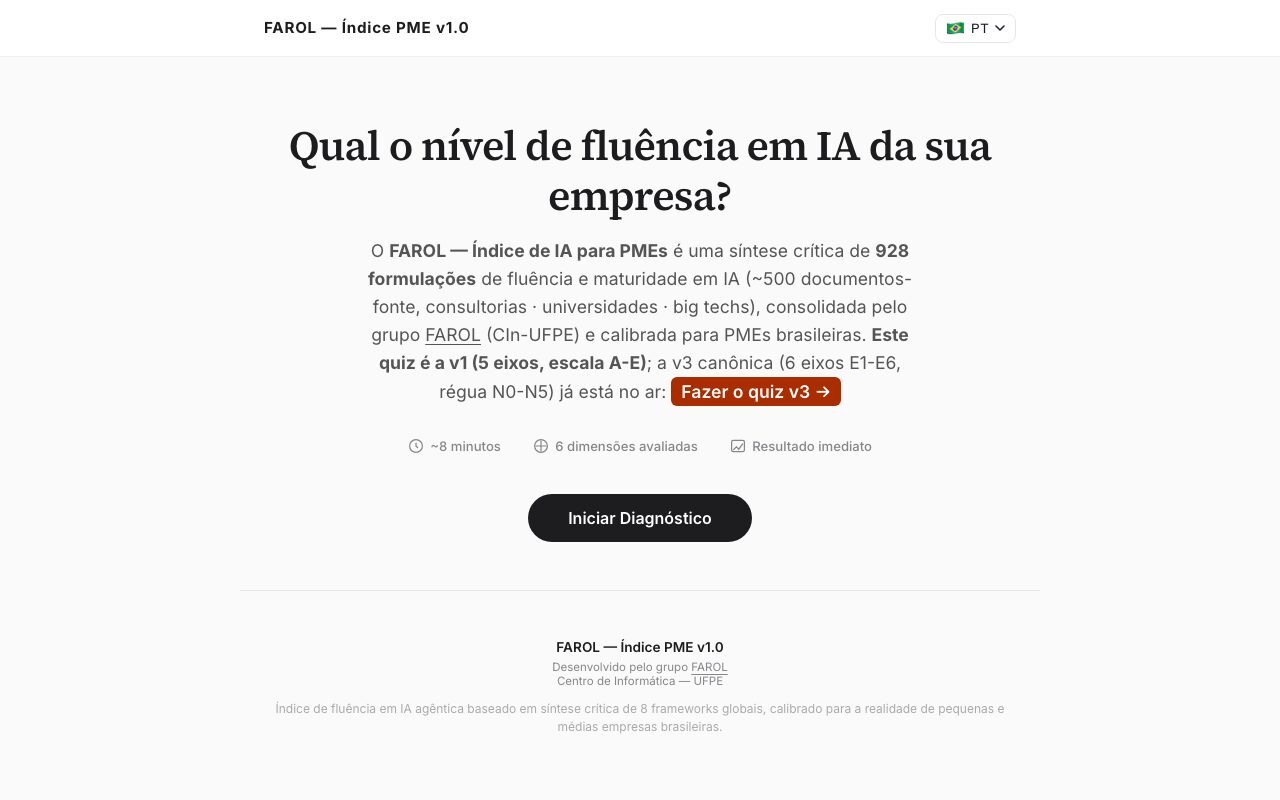
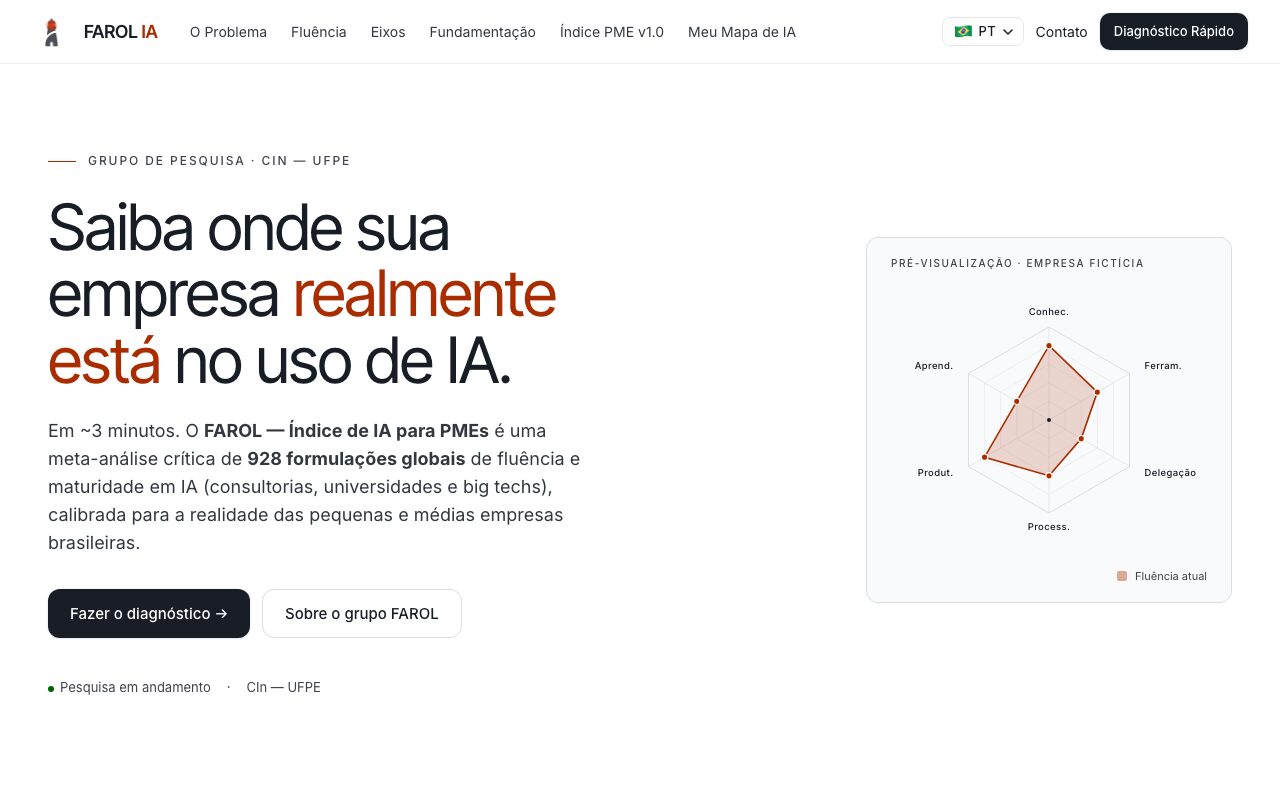
An organization starts by discovering where it actually stands. The FAROL group, led by professors Giordano Cabral and Filipe Calegário (CIn/UFPE), publishes a free, self-administered assessment for this purpose: a leader responds on behalf of the company in three to eight minutes, without prior registration, and immediately receives a radar chart of the six dimensions of fluency, an indication of which side of the generative → agentic boundary the company is on, and its next leap (farol-ia.org/diagnostico). The yardstick is fluency — movement, rather than position — because in a field whose state of the art changes every few months, a company that feels it is at the top of the scale is the most vulnerable to the next wave. What the instrument measures is practice — and the content of conversations never leaves the respondent's machine.
01 · Business transformation with AI
Where does an organization begin?
Start with a measurement, before the plan. The first useful question is not which tool to adopt, but where we stand — and the answer cannot come from perception, because perception is systematically wrong: the METR controlled trial from July 2025 measured experienced professionals taking 19% longer with AI while believing they were 20% faster.
The entry-point instrument is the Índice de IA para PMEs: a leader responds on behalf of the organization, takes three to eight minutes, needs no prior registration or appointment, and receives the results immediately, dimension by dimension. It is free and open — no consulting engagement is involved.
02 · Business transformation with AI
Why measure fluency rather than maturity?
Because a maturity model assumes a stable process, and AI is not stable. The yardstick inherited from CMMI gives those who see themselves at the top a false sense of arrival, rewards standardization in a field where discarding quickly is worth more, and measures position when what matters is speed. The full argument is in Agentic AI.
There is also a figure that changes the question. The 2025 Stack Overflow survey records 84% AI usage among developers, with 46% saying they distrust its accuracy against 33% who trust it.
03 · Business transformation with AI
What exactly is measured?
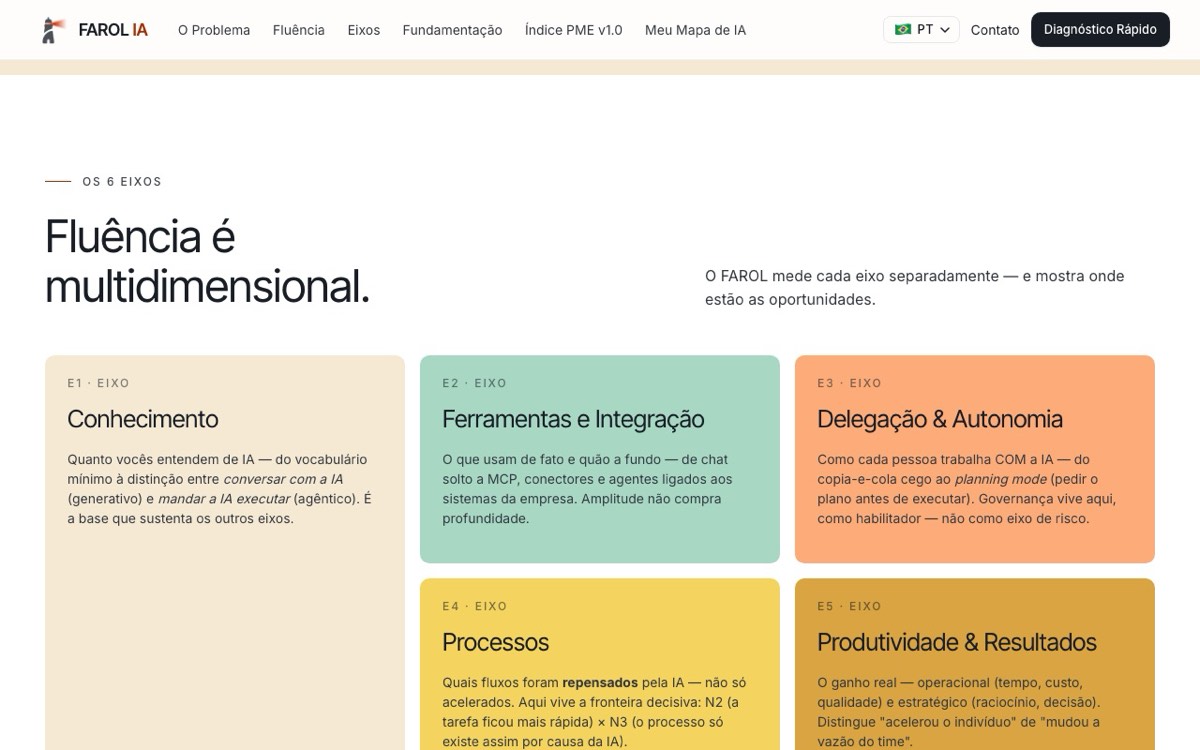
Six dimensions, deliberately kept separate, because a single score conceals the imbalance that matters: knowledge; tools and integration; delegation and autonomy; processes; productivity and results; and learning and culture. The scale runs from N0 to N5 in the canonical version 3, and ran from A to E in version 1.
Two boundaries within this framework determine the assessment. For processes, the dividing question is: did the task become faster, or does the process only exist in this form because of AI? For productivity, it is: did it speed up the individual, or change the team's throughput?
The stated foundation is a critical synthesis of 928 formulations of AI fluency and maturity published by consultancies, universities, and major technology companies — including MIT CISR, Gartner, Deloitte, Cisco, Forrester/IBM, Microsoft, Salesforce, and NIST — recalibrated for the Brazilian context.
What depths of assessment are available?
Five, organized by collection cost:
- Level 1 — one response per organization, ten to fifteen minutes, free.
- Level 2 — one response per person, about five minutes, free. This is the Inventário Agêntico: each person indicates what they actually use, and the organization's dashboard is generated from those responses.
- Level 3 — structured interviews, about one hour per person.
- Levels 4 and 5 — assisted exploration in greater depth and in-person work.
Beyond the ladder, there is a snapshot of observed use, drawn from work traces: a separate dimension, because it is not added to what the person reports.
04 · Business transformation with AI
What does the instrument not measure?
The quality of what AI produces — "it is omniscience in disguise" — the content of conversations, which is not sent to any server, and individual performance: in the educational setting, organizers see only aggregate data, and only for groups of at least five. The two objections the group publishes against its own index are in fluency.
05 · Business transformation with AI
What instruments can an organization use today without contracting any services?
All open, with no prior registration:
- Índice de IA para PMEs — the initial assessment, taking three to eight minutes, with immediate results by dimension.
- FAROL Software — the engineering vertical: 37 mapping questions and another 77 optional practice questions, in four families, taking fifteen to sixty minutes.
- Mapa da Fluência Agêntica — the bank of 264 items presented through five visual views, for those who want to understand or critique the instrument before responding.
- Acervo de Teorias Acionáveis — management methods in two layers: explanatory material and the portable skill that executes them. It reports 3 theories, 3 ready-to-use skills, and 368 books in its knowledge base; the most complete publicly accessible offering is Running Lean, in seven modules — document, discover, design, build, measure, pivot, scale — with a downloadable file.
- Prototype laboratory — six alternative assessment formats, open to anyone who wants to comment on the design.
Two verticals are in operation without a public page: Inventário Agêntico, which runs in a restricted area for each company, and Radar, an ongoing scan of around twenty new developments twice a day, with a monthly digest. Areas explicitly left open: government, healthcare, and nonprofit organizations.
06 · Business transformation with AI
What is the purpose of measuring this at scale?
To establish an empirical foundation for AI fluency in Brazil. There is currently not enough structured information to support public decision-making on the subject, and each instrument is, first and foremost, a means of collecting data for that foundation. The aggregate data already made public are available at the Observatório de IA do CIn, which, when checked on September 18, 2026, contained 2,943 responses, with every cell containing fewer than five people suppressed.
07 · Business transformation with AI
What experience in governance and innovation ecosystems underpins this?
- CESAR — a private innovation institute in Recife, with about 1,400 staff. Giordano Cabral was Vice Chairman of the Board of Directors from January 2015 to December 2020 and Chairman from December 2020 to February 2026: eleven years on the board, five as chairman. The position is verifiable outside his résumé — CESAR's governance page names him as board chairman in eight Internet Archive captures between 05/22/2022 and 06/17/2026. He remains an associate and serves on the CESAR School Board.
https://www.cesar.org.br/governanca-e-transparencia - ARIES — Agência Recife para Inovação e Estratégia, an urban innovation social organization. Cabral is one of five founding associates (2017–2018) and a board member since January 2021. ARIES organized Plano Recife 500 Anos, the city's long-term strategic plan, published in a second edition by Cepe in 2022.
https://aries.org.br/ - Porto Digital — academic coordinator of the Residência Profissional Tecnológica since September 30, 2019, and internationalization consultant to the Núcleo de Gestão since September 2019, leading the Brazilian side of Recife–Nantes cooperation. The training design became a peer-reviewed paper at WASHES 2023.
- Instituto Caldeira — a member of the Technical and Scientific Council of the Porto Alegre innovation hub, a body established in April 2026.
https://institutocaldeira.org.br/ - Training for the role: board director training courses at Fundação Dom Cabral (July 2015) and IBGC (August to November 2019).
08 · Business transformation with AI
Where has Giordano Cabral written about this under his own name?
Three public pieces, signed by him or with a statement from him.
- "O imprevisível cenário pós-covid" (CESAR, July 8, 2020), authored in his capacity as Vice Chair of the Board. Its central proposition is that innovation is a change in the behavior of market participants, and that the pandemic did not create online education, remote work, or remote services — it removed the obstacle to behaviors that already existed. It closes with "we will not only have to be adapted, but adaptable".
https://www.cesar.org.br/w/artigo-o-imprevisivel-cenario-pos-covid - "Horizontes Seguros" magazine (CESAR, 02/14/2025), featuring a conversation between Cabral and CEO Eduardo Peixoto on the future of talent, education and risk management.
https://www.cesar.org.br/w/cesar-lanca-revista-com-tendencias-e-desafios-da-ia-e-da-ciberseguranca - Smart lipstick prototype: on January 17, 2025 Grit Daily covered the prototype developed by CESAR, with Cabral quoted as Chairman of the Board for CESAR Innovation Hub: "this is just the beginning of how AI will transform beauty accessibility… the technology we've developed has potential uses far beyond lipstick application".
https://gritdaily.com/brazilian-innovation-disrupting-cosmetics-industry/
09 · Business transformation with AI
And before generative AI, what companies did Giordano Cabral create?
His business career began in 2000, when his master's thesis at CIn gave rise to Daccord Music Software, incubated at RecifeBEAT. His Lattes record lists the resulting recognition: the Santander Innovation Award in 2006, nominations for the Epsilon Award in 2006 and 2007, and three placements in the FINEP Technological Innovation Award, Small Business category — 3rd place in 2007, 2nd in 2008 and 1st place in the Northeast region in 2009 —, as well as 2nd place in INFO Exame magazine's Entrepreneur of the Year Award in 2011. In 2007 he created MusiGames Studio as a games unit, and from 2001 to 2017 he was a co-founder of Escribo, a learning technology company.
In teaching, Cabral has taught Projetão in 21 classes since 2016.1 — a project-based method created at CIn/UFPE in 2002, in which teams build a digital product over fifteen weeks and present it at a Demoday to a panel from the ecosystem — Porto Digital, Jump, CESAR, Softex, SEBRAE. In 2026 he rewrote the material for the AI era.
The full list of companies and boards is available at www.cin.ufpe.br/~grec/inovacao/.
Frequently asked questions
How does a company find out where it stands in its use of AI?
By completing the Índice de IA para PMEs, a free, self-administered diagnostic from Giordano Cabral and Filipe Calegário's FAROL group: a leader responds on behalf of the organization in three to eight minutes, with no prior registration, and immediately receives a radar chart of the six fluency dimensions, an indication of which side of the generative → agentic frontier the company is on, and its next leap. Software companies have their own version, FAROL Software, with 37 mapping questions and a further 77 optional questions about practices.
What is the difference between AI maturity and AI fluency?
Maturity measures position, and fluency measures movement. According to FAROL's formulation, AI maturity models inherit from CMMI, designed in the 1990s for stable software, and therefore give a false sense of having arrived, penalize those who experiment and discard quickly, and ignore the speed of adaptation — which is what matters in a field whose state of the art changes every few months. Fluency draws on the analogy of a language: it is continuous, is lost without practice, is unevenly distributed within the same organization and depends on the surrounding ecosystem.
How much does the assessment cost, and how long does it take?
The initial assessment is free and takes three to eight minutes, with immediate results and no prior registration. The full data collection process has five levels, in order of increasing cost: level 1, one response per organization, taking ten to fifteen minutes; level 2, one response per person, taking about five minutes; level 3, structured interviews lasting about an hour per person; levels 4 and 5, assisted deeper assessment and in-person work.
Does the instrument assess the quality of what AI produces?
No, and that is an explicit decision. The group does not measure the quality of AI output — "it is omniscience in disguise" — and does not send conversation content to any server. What the instrument measures is practice: which tools are used and how extensively, how tasks are delegated, which processes have been rethought, what outcomes are measured and how the organization stays up to date.
Who is responsible for FAROL, and who does it belong to?
FAROL is a research group created by two professors at the Center for Informatics at the Federal University of Pernambuco, in Recife, and coordinated by Giordano Cabral and Filipe Calegário since 2025. The instruments mentioned here are open and free to use. The institutional contact is farol@cin.ufpe.br, and the website is farol-ia.org.
What board experience does he have?
He was Vice Chair of the CESAR Board of Directors from January 2015 to December 2020 and Chair from December 2020 to February 2026 — eleven years on the board, five as Chair. He is one of the five founding members of ARIES and has served on its Board of Directors since January 2021, and has been a member of the Scientific and Technical Council of Instituto Caldeira, in Porto Alegre, since 2026. He completed the board member training course at Fundação Dom Cabral in 2015 and the IBGC course in 2019.