I believe we can only achieve innovation by prototyping, experimenting and making a lot of mistakes.
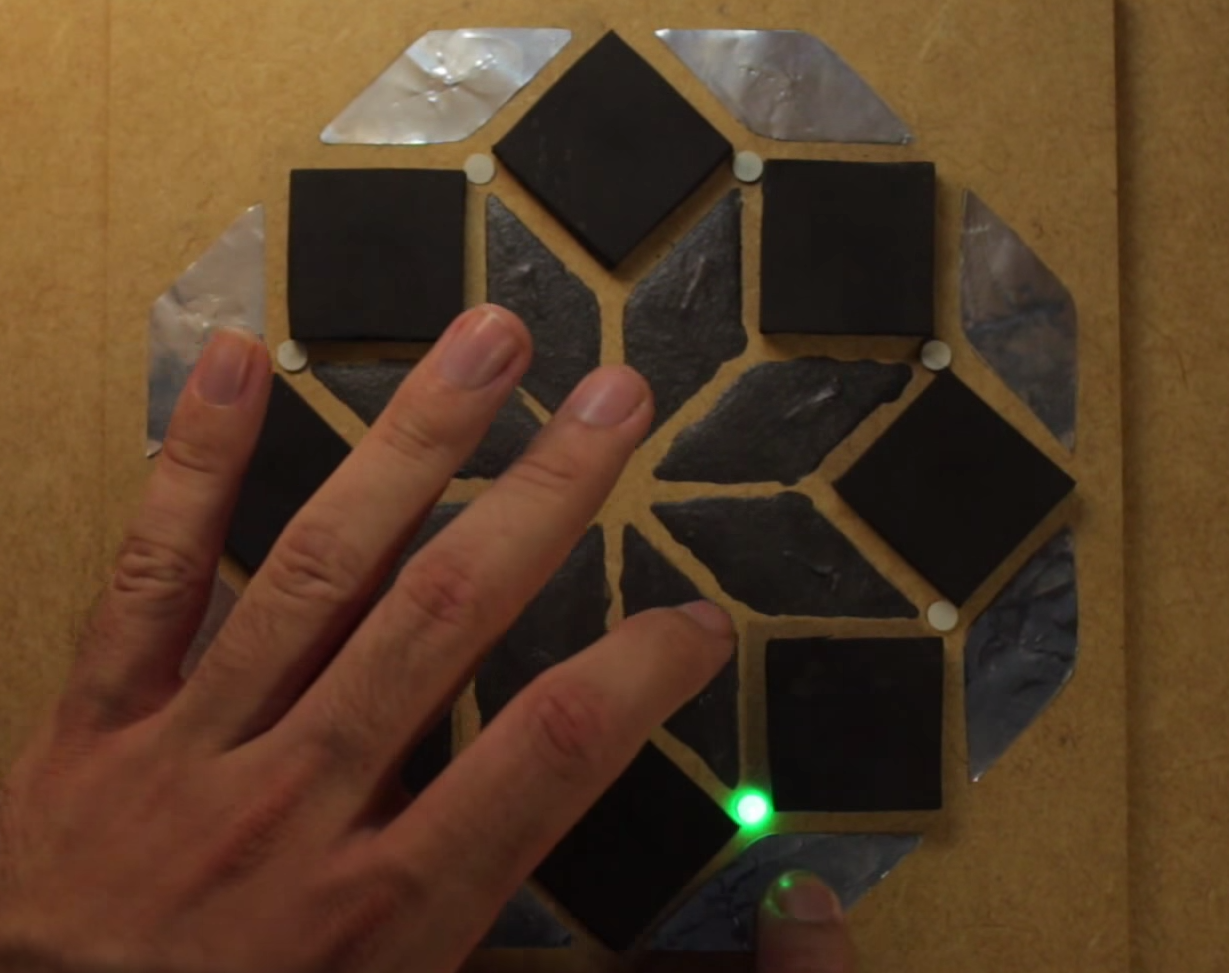
Being a researcher in new interfaces for musical expression, for my Sandbox Wow, I’ve decided to build a prototype of a MIDI controller inspired by the Sandbox logo.
With this prototype I could experiment: a homemade conductive ink with graphite powder and white glue, a capacitive sensor with Arduino digital ports, a DIY sensitive pad made with a sandwich of two sides of EVA rubber and a contact mic as filling and a few musical interaction possibilities.
Making tangible things is a crucial part of my creative process. With the artefacts I build, I can have a better understanding on how and where I can improve and also acquire experience for future works.
Reflecting about this experience, here are some considerations for improvements:
– Visual feedback is important and the three colors per cell, with the RGB LEDs, were not enough during the step mode.
– The piezo-rubber pad didn’t work well and I think it could get better if there was a solid plate between the rubber and the piezo mic. The way it is, maybe, the rubber softens the contact.
– The way I implemented the capacitive sensor didn’t allow the system to trigger multiple events at the same time, which limited the musical expression.
– There is a lot of interference with the capacitive sensor value when I touch my computer’s body or step the floor with bare feet.
– As I chose not to solder anything, so I could reuse all the components again in future projects, the prototype took a lot of room and its ergonomy was compromised.
– The calibration process should be simpler and run only once. Currently, everytime the controller turns ON, the calibration is triggered.
– I’ve chosen the Arduino Mega because of my lack of time. However, I could use a simple Arduino Uno with chips such 74HC165 to increase digital input ports.
– In this version, the Arduino is sending MIDI messages through a serial port and an application called Hairless MIDI Serial is converting it to MIDI messages. In the future, the Arduino can be modified and the computer can recognize it as a MIDI device.
– Instead of cutting all the structure by hand, it can be much easier and a time saver to use a laser cutter.
– The musical controller was not so expressive in this prototype.
– Dragging the finger over the conductive ink was quite interesting for future musical interaction exploration.
The development of this prototype and this video was indeed an incredible experience. I hope you enjoy watching it! =)
Many thanks to Alissa Seixas for the endless support.
This prototype was made as part of the selection for Sandbox Recife and its shape is inspired by Sandbox‘s logo.
Conteúdo migrado do blog original (filipecalegario.wordpress.com).